What you actually see inside the Domus Aurea
The octagonal room
The single most famous space down there, and the one I would go back for on its own. It is an octagon under a domed ceiling with a central oculus, an engineering ancestor of the Pantheon’s dome, and standing under it with light coming down through the opening is the moment the visit turns from interesting into worth the trip. Photographs do not carry it, partly because the scale is the point and partly because it is dark. David, an Australian reviewer, described the whole thing as being able to “literally step into 2000 years of preserved history”, and this is the room he means.
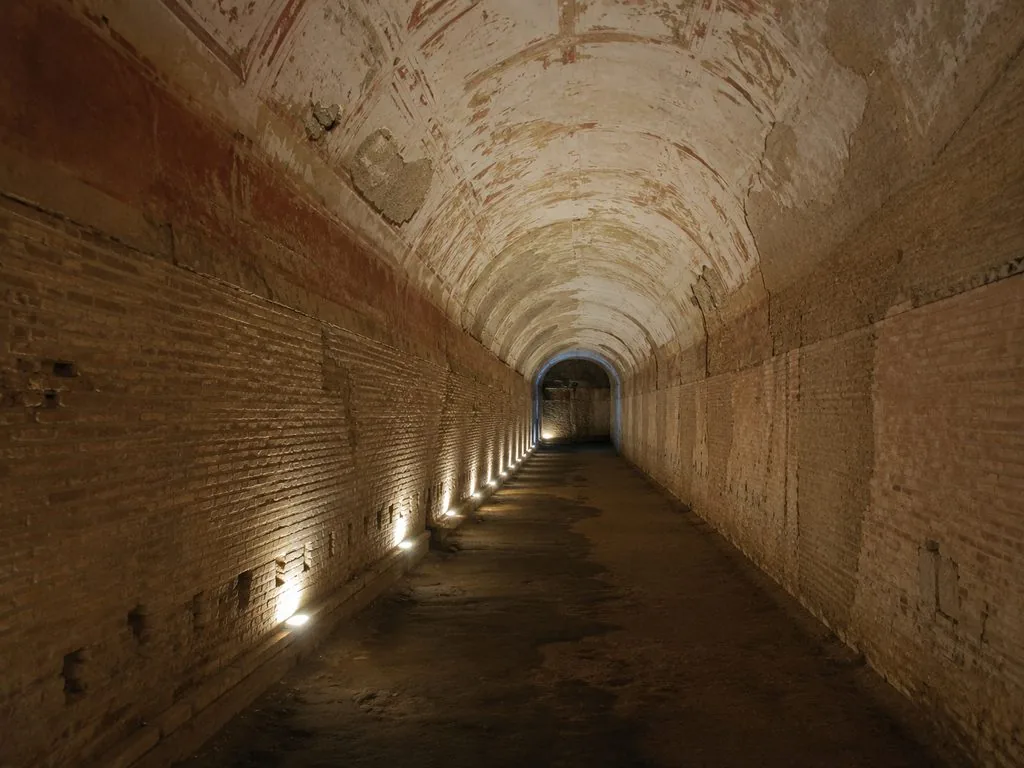
The corridors and the cryptoporticus
Long barrel-vaulted passages, and the cryptoporticus, which is the covered corridor that runs through the complex. They are what you spend most of the ninety minutes walking, and they are where the temperature registers — around 10°C, damp, year-round, per the park’s own figure. The floors are uneven. This is not a stroll, and the hard hat is not decorative — what to wear underground.
The frescoes, which are fragments
Fine white-ground painting survives on the vaults: slender candelabra, floral motifs, small figures. Fragments, not rooms. Set your expectations there and you will be pleased rather than disappointed. These are the paintings Renaissance artists climbed down holes in the hillside to copy, and the reason a word in English is what it is — the grotesque frescoes. Some of their own graffiti is still in the plaster.
The excavation itself
Scaffolding, props, cabling and monitoring equipment are in the rooms with you and are part of the character rather than a blemish on it. The rooms open to visitors also change as work moves, which is why my half-dozen visits have not all been the same visit. If you want a finished, lit, roped-off interior, this is the wrong building. If you want to see how a buried palace is actually held up and read, it is the right one — and it is why there is no unguided entry.
What works
- The octagonal room and its oculus, which alone justify the visit for most people
- Barrel-vaulted corridors and the cryptoporticus at full scale
- Genuine white-ground fresco fragments on the vaults
- A live excavation with its working equipment left in view
- The VR headset fills the surfaces back in, and is included everywhere
Worth knowing
- Bare structure — the marble, gold and ivory went in antiquity
- Frescoes survive as fragments rather than complete schemes
- It is dark, damp and around 10°C, with uneven floors
- Which rooms are open changes as the excavation moves
- You see it at the group’s pace, not your own
Look up more than you think you need to. The vaults carry the surviving painting and the oculus is the best thing in the building, and both are above head height while everyone else is watching their feet on the uneven floor.
Seeing it with the largest evidence base behind you
The most-reviewed of the four products rates 4.5 from 559 reviews, English only, meeting at the corner of Via delle Terme di Tito and Via Nicola Salvi on the park side.
Frequently asked questions
What is inside the Domus Aurea?
Barrel-vaulted corridors, the cryptoporticus, fresco fragments on the vaults and the octagonal room with its domed ceiling and oculus, all in bare brick and concrete, alongside the scaffolding of a live excavation.
Can you see the original frescoes?
Fragments of them, on the vaults — fine white-ground painting with candelabra, floral and figure motifs. They are the paintings Renaissance artists copied, which is where the word grotesque comes from: the full story.
Is there anything left of the gold and marble?
No. The marble, gold and ivory that named the palace were stripped in antiquity, so what survives is the structure. That is what the VR headset is for — see the VR page.
Do you see the same rooms on every visit?
Not necessarily. It is an active excavation and the accessible rooms change as work moves, which is also the stated reason every visit is guided: why there is no walk-in.